
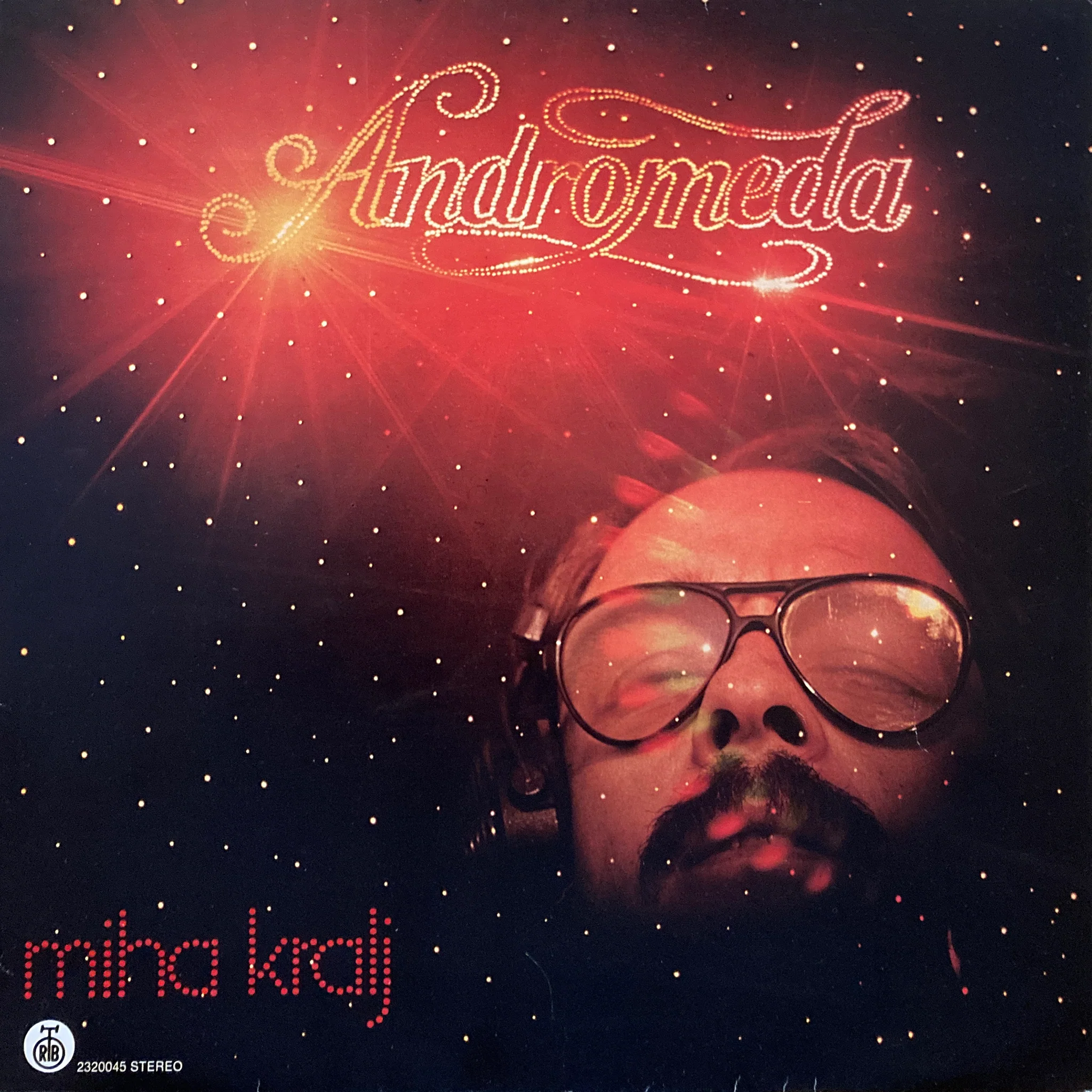
Miha Kralj’s Andromeda (1980) was something Yugoslavia had never really heard before. Often dubbed the “Yugoslav Jean-Michel Jarre,” Kralj was a pioneer of synthesiser music in the region, blending new age, ambient, and electronic textures at a time when most of his peers were still grounded in rock, jazz, or folk traditions. He came from a strong musical background — trained in accordion and piano before falling in love with the machines of the future: Moogs, Hammonds, Bauers, Vox. Out of that fascination came Andromeda, the first ambient/new age record in Yugoslavia, a record that sold tens of thousands of copies at home and abroad, reaching listeners as far as Benelux, Sweden, and even the USSR.
The album’s artwork captures it perfectly: a lone figure (surely Kralj himself) seemingly ascending into the cosmos, bathed in glowing neon. That’s exactly how the record feels — a slow drift upwards, leaving behind the everyday and stepping into an intergalactic soundscape.
The opener, Embrio, is a wonder. It’s atmospheric, spacious, yet grounded with a sprinkle of funk and even some faint Balkan-tinged phrasing. It’s easy to imagine why it found its way into so many Yugoslav documentaries; it has that quality of sparking curiosity, of making the ordinary feel vast and new. Close your eyes and you’re travelling through alien landscapes, seeing strange flora sway under distant suns. For me, this track was a revelation — I’d heard Ex-YU electronic music that was danceable, dark, or pop-driven, but nothing that felt this cosmic.
Simfonija C-mol ratchets up the tension. The pounding bass drum feels like a warning siren while shimmering synths scatter around it like meteors. It plays like the soundtrack to a crisis in deep space — a UFO spotted on the horizon, a black hole pulling you in, a desperate course correction before time runs out.
Then comes Apokalipsa, which somehow mixes that same strangeness with a fragile beauty. It’s tense but also tender, as if Kralj is staging a cautious dance among the stars. The synth textures are scattered like stardust, experimental yet never alienating.
The title track, Andromeda, became the composition that defined him — even serving as the soundtrack to Planica ski jumping broadcasts, where it played during slow-motion replays. Hearing it, you understand why. It’s delicate, dreamlike, but also charged with a soaring quality that moves — whether in space or on snowy mountains — feel monumental.
Wizard is harder to track down these days, lost in the shuffle of scattered uploads, but the 2023 reissue has thankfully brought the album back into circulation in a gorgeous gatefold sleeve. It’s on my list to pick up — this is one of those records you want in physical form, not just on a playlist.
Finally, Pegaz closes things out in fitting fashion. It’s nostalgic, soothing, and contemplative, like the ship finally coasting into safe orbit. I can only imagine how perfect it must feel to put this on while stargazing, the music weaving itself into the night sky.
Listening to Andromeda today, it still feels ahead of its time. Not everything clicks perfectly, but when it does, it’s spellbinding — a rare Yugoslav record that looks not inward but outward, turning its gaze to the stars. For me, it’s less an album and more a galaxy — Andromeda — a place you step into for 35 minutes. A pioneering work, and one that shows just how wide the universe of Ex-YU music really was.