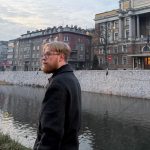

Manja Ristić is a Belgrade-born violinist, sound artist, and researcher whose work sits at the intersection of electro-acoustics, field recording, and experimental sound art. Classically trained at the Belgrade Music Academy and later the Royal College of Music in London, her practice extends into theatre, film, radio art, and interdisciplinary sound research.
The album is framed by a dystopian narrative set in the year 2221, where ecological collapse, imperial warfare, and the erosion of human rights have reached their most extreme conclusions. Within this imagined future, Ristić places fragile sanctuaries — beautiful islands like Mljet in the Adriatic or the Scottish Isle of Arran — where traces of life persist. This conceptual backdrop isn’t delivered didactically; instead, it quietly bleeds into the sound design through restrained droning, hydrophone recording,s and carefully placed environmental textures.
Wounded Sky opens the record with flowing, watery sounds that feel almost soothing at first, like a stream accompanied by a soft coastal breeze. But there’s an underlying distortion to the recording — a subtle wrongness — that gives the piece an uneasy, dystopian edge. Later, low rumbling tones emerge, resembling distant thunder, shifting the mood from calm observation to looming threat. It recalls the quiet environmental unease of Hiroshi Yoshimura’s work, but with a darker, more foreboding undercurrent.

The Abyss continues in a slow, progressive manner, unfolding patiently through spacious droning and delicate sonic shifts. Throughout the album, Ristić’s violin and synths rarely appear in a traditional sense, instead dissolving into drones and environmental textures that blur the line between instrument, landscape, and noise. The production is notably strong: everything feels intentional, clean, and minimalist, allowing small details to carry a substantial emotional weight.
On Sacred Land, the atmosphere turns more unsettling. Insects buzz in and out of the stereo field, creating a rotten, almost claustrophobic texture. It’s deliberately uncomfortable, evoking decay and ecological collapse. The piece carries a hopeless sense of dread — desolate, hostile, and quietly tragic.
The album closes with Halcyon’s Nest, which feels darker and more monumental, yet paradoxically calmer than what precedes it. Ristić’s iconic violin finally emerges in a more recognisable form, its mournful presence deepening the track’s sadness as it blends into the hollow resonance of Atlantic shells and drifting drones. It doesn’t offer resolution so much as realisation — an acceptance of fragile survival rather than redemption.
Sargassum aeterna is an eerie record that rewards focused listening. Its soundscapes are beautifully crafted, offering a quiet panorama of a possible future shaped by loss, survival, and fragile continuity. Working through restraint and atmosphere, the album slowly estranges familiar natural sounds until they begin to feel like echoes from a world already slipping away — unsettling, mournful, and deeply resonant.
Where to Find Them
- Instagram: @artar.veltemar
- Bandcamp: listen & support on Bandcamp