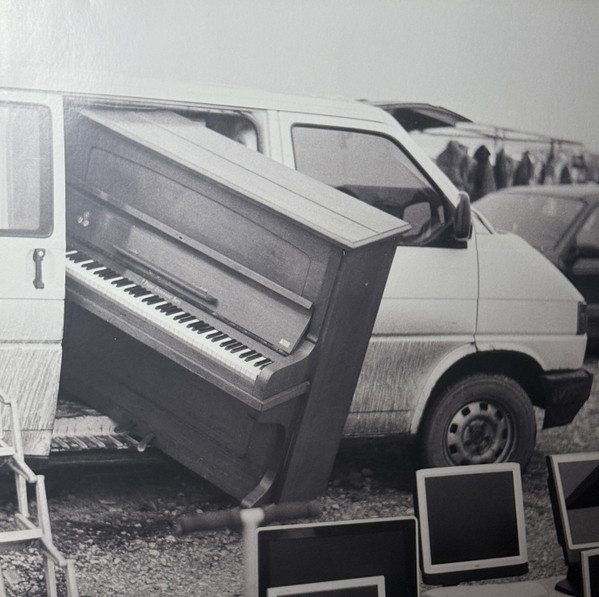

Disciplina Kičme’s debut album Sviđa mi se da ti ne bude prijatno (1983) stands as one of the most uncompromising statements to emerge from the Yugoslav underground. Recorded in Ljubljana and released via Helidon, the record strips rock music down to its bare essentials — bass and drums — and rebuilds it into something abrasive and entirely minimal.
Emerging in the aftermath of Šarlo Akrobata, the project reflects a decisive split in artistic direction. While Ekatarina Velika would pursue a more melodic and expansive sound, Dušan “Koja” Kojić moved toward something far more confrontational. Together with Srđan Todorović on drums, Disciplina Kičme operates as a two-piece built on tension, repetition, and raw physical energy.
The absence of a guitar defines the record immediately. Koja’s bass is not supportive — it is the music itself. Distorted, percussive, and constantly shifting between groove and dissonance, it takes on a role typically reserved for lead instruments. Tracks like Pobednici highlight this approach clearly: driven by tight, relentless drumming, the bass creates a dark, almost hypnotic atmosphere while maintaining a sense of forward motion. The interplay between the two instruments is remarkably full, suggesting far more than the sum of its parts.
At the same time, the album thrives on fragmentation. Ti znaš da tvoja soba ima četiri ugla captures the band’s claustrophobic edge through minimal, repetitive lyrics that feel less like storytelling and more like psychological pressure. The imagery is simple, almost absurd, yet deeply unsettling — repetition transforms it into something oppressive, as if the listener is trapped inside the same confined space described in the song.
That tension between rhythm and discomfort carries into Nemoj, where frenetic drumming and handclaps introduce a strange, almost dance-punk quality beneath the chaos. The lyrics, reduced to short, repeated phrases, blur the line between meaning and sound. Like much of the album, they function as an additional instrument — percussive, fragmented, and deliberately ambiguous. The result is a track that feels both physical and disorienting.
Elsewhere, Mladost ne opravdava besvest pushes the band further into experimental territory. The bass takes on a near-Hendrix-like psychedelic quality, oscillating between noise and melody, while the repeated vocal line — “youth does not excuse recklessness” — lands with the weight of a mantra. The track feels eerie and unstable, built on a sense of slow, creeping tension rather than release.
Even in its more groove-oriented moments, such as Zgodne kretnje, the album refuses to settle into comfort. There is a clear sense of rhythm — even hints of funk, but it is always distorted, slightly off-balance, and charged with underlying aggression. The music invites movement, yet resists it at the same time.
This duality defines the record. It is both structured and chaotic, minimal yet dense in atmosphere. Tracks like Pečati feel almost improvised, as if the band is testing the limits of its own format in real time, while others lock into repetitive patterns that build tension through sheer persistence.
If there is a limitation, it lies in the very approach that makes the album so distinctive. The stripped-down instrumentation and reliance on repetition can, at times, verge on monotony. Uživaj hints at this constraint, circling its central idea without fully expanding it. Yet even here, the rawness of execution keeps the music engaging — the sense of immediacy outweighs any structural shortcomings.
The album closes with Javno veselje, its most overtly unsettling moment. Built around a repeated, almost nihilistic refrain, the track leans fully into absurdity and disillusionment. It feels less like a conclusion and more like a collapse — a final statement that offers no resolution, only tension suspended in place.
Sviđa mi se da ti ne bude prijatno is not an easy record. It is abrasive, repetitive, and at times deliberately alienating. But it is also one of the most original and forward-thinking albums to emerge from the Yugoslav scene.
Where Šarlo Akrobata hinted at fragmentation and experimentation, Disciplina Kičme fully embraces it. In doing so, they create a sound that feels both primitive and ahead of its time — a raw, physical, and uncompromising vision built on nothing more than bass, drums, and intent.