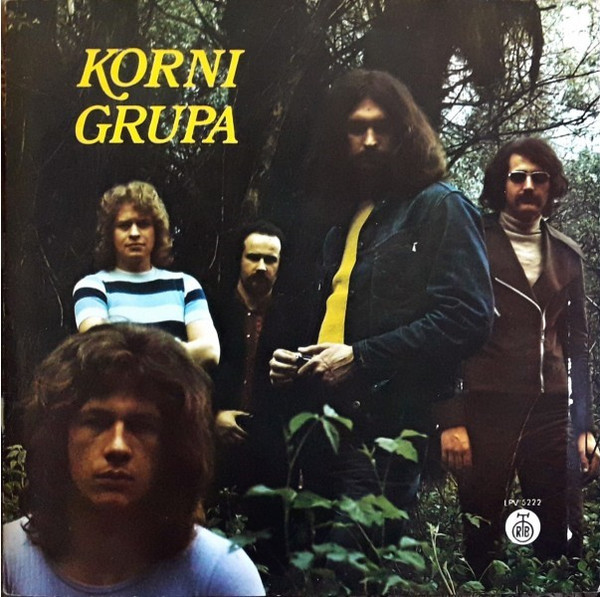
Few records capture the birth of Yugoslav rock as clearly as the self-titled debut by Korni Grupa. Released in 1972, it stands not only as the band’s first full-length album, but as one of the earliest rock LPs recorded in Yugoslavia — a moment when the scene was still transitioning from singles and 7” releases into more ambitious, album-oriented work.
Formed in Belgrade in 1968 and led by keyboardist Kornelije Kovač, Korni Grupa quickly established themselves as one of the most technically accomplished and forward-thinking bands in the country. With a rotating cast of vocalists — including future stars like Dado Topić and Zdravko Čolić — the group eventually settled on Zlatko Pejaković for this debut, completing a lineup that balanced virtuosity with accessibility.
Musically, Korni Grupa sits at the intersection of progressive rock, jazz-rock, and psychedelic hard rock. At its core is Kovač’s keyboard work — fluid, expressive, and often leading the compositions rather than simply supporting them. His use of piano, organ, and early synthesisers gives the album a distinctive identity, one that would go on to influence generations of Yugoslav musicians, from Smak and Leb i sol to later new wave and rock acts.
The album opens with Glas sa obale boja, immediately establishing its musical scope. Funk-inflected rhythms, tight drumming, and expressive guitar lines intertwine with rich keyboard textures, while the vocals carry a slightly theatrical, almost symphonic quality. It’s a confident introduction — dynamic, melodic, and technically impressive without feeling overindulgent.
The centrepiece of the record arrives with Put za istok, a multi-part composition stretching toward fifteen minutes. Here, the band fully embraces progressive rock structure, moving through shifting sections that blend jazz improvisation with tightly arranged passages. The interplay between keyboards and guitar is particularly striking, with Kovač’s melodic instincts anchoring even the most exploratory moments. It’s a track that not only defines the album, but also hints at the broader ambitions of Yugoslav rock at the time.
On Moj bol, the band leans further into jazz-rock territory. The arrangement unfolds gradually, built on piano-led passages and subtle rhythmic shifts, before expanding into something more dramatic and expansive. Like much of the album, it reflects the era’s fascination with longer form tracks — compositions that evolve and reward attentive listening.
The second half of the record continues in a similar vein, though with slightly less focus. Bezglave JA-HA horde explores jazz fusion more directly, while Tata ko i mama Spo introduces a more accessible, almost pop-rock sensibility, without entirely abandoning the band’s progressive foundation. These tracks occasionally feel less cohesive than the material on the first side, but they still showcase the band’s versatility and musical range.
If the album has a limitation, it lies in this unevenness. Side A feels tightly constructed and purposeful, while Side B drifts slightly, exploring ideas without always fully developing them. Yet even in these moments, the level of musicianship remains undeniable.
What ultimately defines Korni Grupa is not just its sound, but its significance. At a time when Yugoslav rock was still finding its footing, this was a record that proved local musicians could operate on the same level as their Western counterparts. Korni Grupa remains a foundational work: ambitious, technically accomplished, and historically essential.