Haustor’s third album Bolero is, on the surface, a vibrant collision of styles — new wave, art rock, funk, reggae, even early traces of hip hop — all woven together with a sense of rhythm that feels almost celebratory. But returning to it now, years after my first encounter, it reveals itself as something far more layered: an album where joy and melancholy coexist in quiet tension.
Produced by Mitar Subotić, Bolero carries a richness in sound that allows each track to breathe. The arrangements are dense but purposeful, theatrical without feeling overwhelming. It is an album that invites you in with movement, only to gradually confront you with stillness.
This was the record that first drew me into EX-YU music. Tracks like Šal od svile initially captivated me through their atmosphere alone — the suspense, the rhythm, the sense of something novel yet deeply compelling. At the time, I approached Bolero instinctively, almost passively, drawn to its surface energy rather than its deeper narrative.
But over time, that relationship has shifted, and what once felt lighthearted now feels deceptive. Beneath the rhythmic playfulness lies a series of narratives that are often deeply melancholic — stories of escape, detachment, and emotional fragmentation. In revisiting the album, I find myself less interested in how it sounds, and more in what it reveals.
The opening track immediately establishes the album’s tonal duality. Bolero unfolds with a carnival-like atmosphere — driven by a strong bass-line, vibrant brass arrangements, and a rhythmic pulse that feels ceremonial in a samba-like way. There is something almost processional about it, as if the listener is being ushered into a space where everything is in motion.
“Pogledaj koliko ljudi vani / pogledaj sva ta čudna lica…”
“Look at how many people are outside / look at all those strange faces…”
The imagery is outward-facing, communal. The city becomes a stage, and the act of movement — of joining the crowd, of dancing — takes on a ritualistic quality. The repeated invitation to “osjete rhythm i plešu bolero” — “feel the rhythm and dance the bolero” — feels hypnotic, like a surrender to the moment.
Yet even here, there is a subtle unease. The faces are čudna — strange — the gazes unusually intense. What initially feels like celebration begins to carry an undercurrent of disorientation. As an introduction, Bolero functions as a vibrant entry point into the record, acting as a facade for the emotional complexity awaiting beneath.
The following track, Ena, an EX-YU classic, turns sharply inward. Musically, it retains that same sense of movement — its reggae-inflected rhythm, warm bass-lines, and fluid arrangement give it an almost comforting quality. There is an ease to the sound, something familiar and full of joy. But lyrically, the song begins to unravel that comfort almost immediately.
Ena presents itself as a story of a relationship, but one defined less by connection and more by imbalance. Ena appears as someone who offers stability — she understands the narrator’s cycles, anticipates his collapse, and provides refuge when needed. Yet that care is not without weight.
“Ja, Ena, nisam tvoj sin, zapamti to…”
“Ena, I am not your son, remember that…”
This line becomes the emotional centre of the song. Ena’s love is framed as protective, almost maternal, while the narrator resists being placed within that dynamic. What she offers is safety; what he insists on preserving is distance, and in that tension lies the core of the song.
As the narrative unfolds, Ena gradually shifts from a concrete figure into something more abstract. By the final verse, she exists primarily in memory and dream: “Ja često sretnem Enu u svojim snovima” — “I often meet Ena in my dreams.” The relationship is no longer active, but its presence lingers, shaping the narrator’s sense of self even in absence.
The image of the “plava sjena u crnim očima” — “a blue shadow in black eyes” — is particularly striking. It suggests that Ena, too, carries the residue of what has passed — that even in moments of happiness, something unresolved remains visible.
This is what makes Ena so difficult to reduce to a single meaning. It can be read as a story of a failed relationship, but it also invites a broader interpretation. Ena may represent stability itself — a fixed point the narrator cannot fully accept. In that sense, the song isn’t reduced to a love story, rather the impossibility of return.
The refrain reinforces this sense of finality:
“Do mene nema puta / pogledaj, sve je bijelo, zima je”
“There is no way to reach me / look, everything is white, it is winter.”
Winter represents closure — the path between them has disappeared entirely.
Where other significant records of the time, like Azra’s Filigranski pločnici, capture fragmentation through the external world — through streets, encounters, and the restless movement of the city — Haustor internalise that same instability.
From here, Bolero continues to shift between outward spectacle and inward disintegration. Tracks like Tv Man and Sejmeni expand the album’s sonic palette, but they also reinforce its central tension: the contrast between movement and meaning, between performance and what lies beneath it.
Tv Man shifts Bolero into a more abstract, atmospheric space. Built around a shadowy, dub-infused sound, the track carries a distinctly nocturnal feeling, like moving through the city long after curfew. The synths add an ethereal layer, giving everything a hazy, almost unreal quality, as if the scene is unfolding somewhere between memory and dream.
The lyrics are delivered in a spoken-word style, slowly recited rather than sung, which reinforces that sense of distance. The stage feels fragmented, cinematic, and slightly disorienting.
At its core, Tv Man sets up a quiet contrast between two worlds. Outside, the narrator walks through darkness, rain, and near-deserted streets, suspended in a space that feels both intimate and detached. Inside, “ljudi u domovima prate program” — “people in their homes are watching the programme” — silent, passive, watching. It is a subtle but striking image of a society turned inward.
The figure of the Tv Man himself is deliberately elusive. He does not speak or interact — he simply ide — goes. That movement feels almost mechanical, as if he represents something larger than an individual: routine, passivity, or the quiet normalisation of a life lived at a distance.
As the song progresses, the outside world begins to dissolve. Houses, faces, entire streets disappear into darkness, leaving only “plavi prozori” — blue windows — suspended in the night. It is one of the album’s most evocative images, suggesting a city that still exists, but only as a series of distant glowing screens.
Sejmeni introduces a more overtly political and confrontational dimension to Bolero, but, like much of the album, and in contrast to contemporaries like Azra, it avoids direct statements in favour of atmosphere and suggestion. From its opening lines: “miris nafte, miris znoja” — “the smell of oil, the smell of sweat”, the song immediately establishes a sense of tension, placing the listener in a volatile, industrial space.
The structure of the lyrics builds this unease gradually. The repeated layering:
“iza pušaka su oči / iza očiju su ruke / iza ruku kuca srce”
“Behind the rifles are eyes / behind the eyes are hands / behind the hands, a heart is beating.”
It moves from object to human, from violence to vulnerability. It strips away the abstraction of conflict and reveals something more intimate beneath it: fear, anticipation, and the undeniable presence of the individual within collective struggle.
Musically, the track reinforces this duality. The groove is steady and hypnotic, while the chorus — “bejbe, ne boj se” — “baby, don’t be afraid” — introduces a tender counterpoint. It is as if the song exists simultaneously on two levels: one of large-scale resistance, and another of personal reassurance.
As the narrative unfolds, the imagery becomes more explicit as figures gather at the edges of the city. The invocation of “no pasarán” situates the song within a broader history of resistance. The sejmeni themselves remain somewhat ambiguous. Historically associated with enforcers or armed retainers, here they take on a more symbolic role — figures of authority, repression, or incoming force. Their arrival carries a sense of inevitability:
“Sejmeni dolaze / lance nam donose”
“The sejmeni are coming / they are bringing us chains.”
“ljudi ih gledaju / proći im ne daju.”
“People watch them / they do not let them pass.”
In that sense, Sejmeni captures the moment just before action — the tension between fear and defiance.
Side B opens with Take the Money and Run, one of the album’s most stylistically unexpected tracks. Drawing from early hip hop and electro influences, it stands out immediately. The rhythm is stripped down yet insistent, built around repetition, voice, and cadence rather than melody.
At first glance, the track can feel playful, even slightly dated. But beneath that surface lies something more deliberate. The repeated line: “There is no reason for you to turn around… so will you listen to me, my son?”, introduces a voice of authority that feels persuasive and subtly manipulative.
“Take money and run.”
That refrain is both simple and unsettling. It reduces everything — morality, consequence, reflection — into a single imperative.
The presence of Rade Šerbedžija in the interlude amplifies the theatrical dimension, blurring the line between song and performance. The recurring image of the shadow — “Your shadow is catching you…” — suggests that escape is never complete.
Positioned after Sejmeni, the shift is striking. Where that track deals with collective resistance, Take the Money and Run turns inward, towards individual survival, opportunism, and escape.
Ja želim initially comes across as one of the more direct tracks on Bolero, leaning more clearly into new wave and post-punk aesthetics. Compared to the surrounding songs, it feels more grounded, built around a strong melodic core.
But that simplicity is deceptive. Lyrically, the song reduces everything to longing:
“Ja želim tako smiješno malo / u par njenih osmjeha sve bi stalo”
“I want so ridiculously little / everything could fit into just a few of her smiles.”
“Bez tebe sve je tako prazno / osjećam snažno da sve je lažno”
“Without you everything is so empty / I feel so strongly that everything is false.”
There is no ambiguity here, only emptiness, and the sense that everything outside of this connection lacks meaning. Within the album, Ja želim feels like a moment of clarity, stripping everything back to something immediate and human.
Šejn leans into Darko Rundek’s fascination with Western imagery, but quickly becomes something more symbolic. From the opening line — “Ja cijeli život sanjam kako odlazim uz rijeku…” — “All my life I dream of leaving along the river…” — the song is framed as a dream rather than reality.
“Da sam Šejn”
“If I were Shane.”
The narrator is not Šejn, he wants to be, and that gap becomes the emotional centre of the song.
As the imagery unfolds, the frontier begins to merge with something more personal. The granica becomes existential, reflecting a broader instability:
“Dok živim život koji nisam birao sam”
“While I live a life I did not choose for myself.”
Musically, the track mirrors this tension, blending reggae rhythms with cinematic elements. The gradual build from restrained delivery to a more expansive arrangement parallels the movement from intimate dream to heightened, almost theatrical vision.
Positioned within the album, it reinforces identity as something fluid and often performed. Like the narrator of Ena or the drifting figures of Tv Man, the speaker moves between realities, never fully inhabiting any of them.
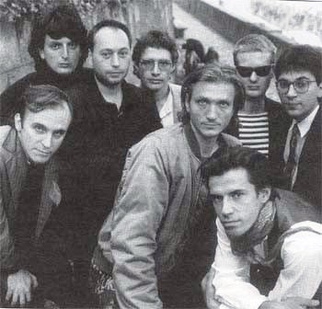
The album closes with Šal od svile, a beautiful and restrained ballad. For me, this was the entry point into EX-YU music — a song that revealed more with each listen, soundtracking long journeys through the London Underground.
The arrangement allows space for each element to resonate — particularly the saxophone, which carries a quiet emotional weight. Lyrically, the song is one of the album’s most poetic and unsettling moments:
“Ja sam bio pogrešan…”
“I was wrong…”
The references to “strane” — sides, and “zastave” — flags, expands the scope beyond the individual, suggesting a world divided by imposed identities.
“Ispod svih tih zastava… ne postoji mjesto…”
“Beneath all those flags… there is no place…”
This becomes one of the album’s most striking ideas: beneath all divisions, there is no true space for authenticity. As the song unfolds, the narrator is both participant and outsider — “protiv volje umiješan” — “involved against my will.” And then comes the shift:
“Ja sam slobodan”
“I am free.”
Whether this freedom is real or imagined is left unresolved. The image of the “šal od svile” — the silk scarf — feels like a final gesture of release, light and untethered. This is where the song remains ambiguous. It can be read as liberation, breaking away from imposed structures and expectations, but also as disappearance — a freedom that may come at the cost of self.
Rather than resolving the album’s themes, they all converge here into a quiet, distilled acceptance.
In revisiting Bolero, what once felt like a vibrant, genre-blending record now reveals itself as something far more introspective. Its rhythms still move, its melodies still invite, but beneath them lies a persistent sense of painful dislocation, of characters searching for meaning, for identity, for a place to belong.
From the outward spectacle of Bolero to the internal fractures of Ena, from the detachment of Tv Man to the imagined identity of Šejn, the album continuously shifts between worlds. By the time it reaches Šal od svile, that movement comes to rest.
Haustor’s third record is a meditation on identity and escape, but also on the impossibility of escape — on the roles we inhabit and the selves we leave behind. And in that sense, Bolero does not simply reflect a moment in time, but captures something far more enduring: the quiet, persistent instability of being.