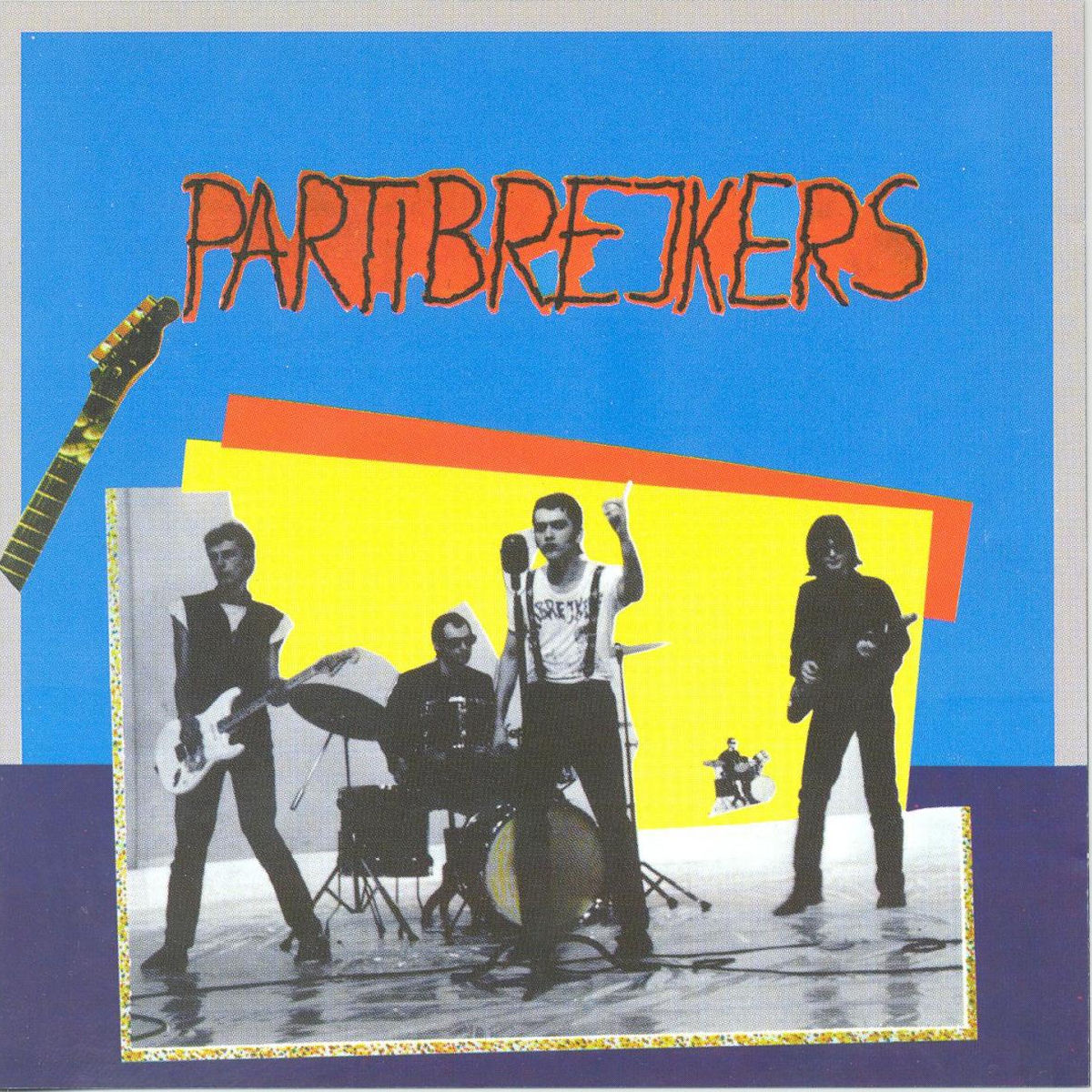
Partibrejkers’ 1985 debut Partibrejkers I captures the band at their most raw and stripped-down, before they would go on to fully refine their signature blend of garage rock, punk blues, and street-level rock’n’roll. Emerging from the Belgrade underground, the band already sound fully committed to a minimal setup — just guitars, drums, and vocals — with no bass guitar, a choice that gives the record a sharp, exposed, and almost abrasive character.
Produced by Dušan Kojić “Koja” of Disciplina Kičme, the album carries an interesting creative tension. Koja’s own work is deeply rooted in bass-driven minimalism and experimental art punk, yet here he helps shape a record defined by its absence of bass entirely. The result is a sound that feels intentionally skeletal, where guitars are pushed to the forefront and everything revolves around rhythm, riff, and vocal grit.
From the opening tracks Ako si… and Gubitnik, the band establish their core identity immediately. Heavy, late-70s-influenced garage rock riffs drive both songs forward, while the vocals sit somewhere between raw punk delivery and blues-inflected shouting. There’s a directness here that feels unpolished but intentional — a band focused on energy rather than refinement.
Noć pushes further into punk blues territory, faster and more urgent, with a strong sense of rhythmic propulsion. The blues influence becomes more apparent here, not in structure but in attitude — a raw emotional edge delivered through distortion and repetition rather than technical complexity.
One of the standout moments arrives with 1000 godina, which leans into a more accessible, almost anthem-like structure. The track opens with acoustic guitar and harmonica, introducing a slightly looser, more danceable groove before exploding into a heavier rock framework. It’s one of the clearest examples of the band’s ability to merge blues tradition with punk energy, and arguably the most immediately memorable track on the record.
Stoj, Džoni continues this lineage, directly referencing “Johnny B. Goode” and the broader rock’n’roll tradition that heavily informs Partibrejkers’ sound. Rather than simply imitating it, the band filter those influences through a harsher, more urban lens, grounding it in the realities of Belgrade’s underground scene.
Across the record, the strengths are clear: strong guitar work, a tight rhythmic foundation despite the minimal setup, and an undeniable sense of raw energy. However, the album can also feel uneven. The lack of bass sometimes exposes limitations in arrangement, and certain tracks blur together in tone and structure. The vocal delivery, while charismatic in bursts, can also feel inconsistent across the runtime. Ulicni hodac even sounds quite grungey, heavy, foreshadowing the sludgey sound of bands like Nirvana – an underrated track for sure.
Still, what Partibrejkers I captures most effectively is potential. It’s not a fully polished statement, but rather a blueprint for what the band would later refine into one of the most important garage rock sounds in the Yugoslav scene. The rawness here is part of its identity — a band still searching for balance between blues tradition and punk immediacy, but already clearly onto something vital.
In retrospect, it stands as an imperfect but essential debut: rough around the edges, occasionally repetitive, but full of the energy and attitude that would define Partibrejkers’ legacy in the years to come.