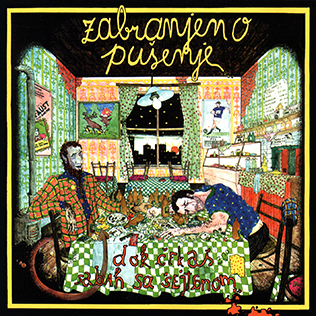
Zabranjeno Pušenje’s second album Dok čekaš sabah sa šejtanom continues directly from the explosive satirical world of their debut Das ist Walter, but shifts the balance slightly toward a more polished, accessible, and musically varied sound. The band retain their sharp social commentary and New Primitivist identity, now wrapped in tighter songwriting and catchier choruses.
Where their debut felt like a raw and novel cultural statement — chaotic, hilarious, and razor sharp in its narrative construction — this record feels slightly more grandiose in scope, more diverse in tone, and in many ways more musically adventurous, even if it occasionally loses some of the immediacy that made Das ist Walter so great.
Tracks like Stanje šoka capture the band at their most energetic and direct. Driven by chugging garage rock riffs and playful instrumentation, it carries a sense of raw vitality, with flashes of flute and keys adding colour without softening the edge. There’s an undeniable sense of movement and humour here — the kind of chaotic joy that feels central to the band’s identity.
Elsewhere, Djevojčice kojima miriše koža slows things down into a more reflective punk ballad, exploring social divides between Sarajevo’s different worlds. It’s a classic example of their pub rock storytelling approach: grounded, observational, and deeply tied to the city’s texture and class dynamics.
One of the defining tracks, Lutka sa naslovne strane, distills everything Zabranjeno Pušenje do best. Catchy, satirical, and deceptively simple, it critiques media, image, and consumption through sharp humour and memorable hooks. It’s a perfect example of how the band balance accessibility with layered social commentary, using humour that often feels closer to self-deprecating British satire than anything polished or abstract.
The title track, Dok čekaš sabah sa šejtanom, leans more heavily into new wave influence, with angular basslines and a slightly darker tone. Interestingly, the vocal delivery carries a raw, nasal quality that reminds me of Liam Gallagher — reinforcing how rooted the band are in a “music of the streets” tradition, even as their sound evolved.
Ja imam kuhinju stands out as one of the album’s more surreal and humorous pieces, turning consumerist absurdity into a repeated mantra that slowly becomes its own joke. It continues the band’s tendency to blur satire and everyday observation, where humour often reveals something uncomfortable underneath.
At points, the album even edges into more experimental territory. Učini da budem vuk introduces technical, almost prog-like elements, combining Led Zeppelin-style riffing with dissonant textures that hint at something more chaotic beneath the surface. Similarly, Nedelja kad je otišao Hase has developed a layered interpretation over time — often read as a coded reflection on Tito’s death, disguised through football imagery and collective memory. It’s a clear example of how Zabranjeno Pušenje embed political and emotional weight beneath apparently simple narratives.
Later tracks like Kažu mi da novog frajera imaš bring the album back into more grounded territory, focusing on themes of pride, relationships, and everyday masculinity, delivered with the same mix of humour and directness that defines the record.
Taken as a whole, Dok čekaš sabah sa šejtanom feels like a band expanding outward rather than refining inward. It is more polished, more accessible, and more varied than its predecessor — and while that sometimes softens the impact of their satire and tight narrative control, it also shows a group confident enough to stretch their sound without losing their identity.
Compared directly to Das ist Walter, it lacks that same perfectly contained chaos. But as a follow-up, it confirmed Zabranjeno Pušenje as one of the most important, conceptually sharp, and creatively fearless bands of the Yugoslav new wave era.