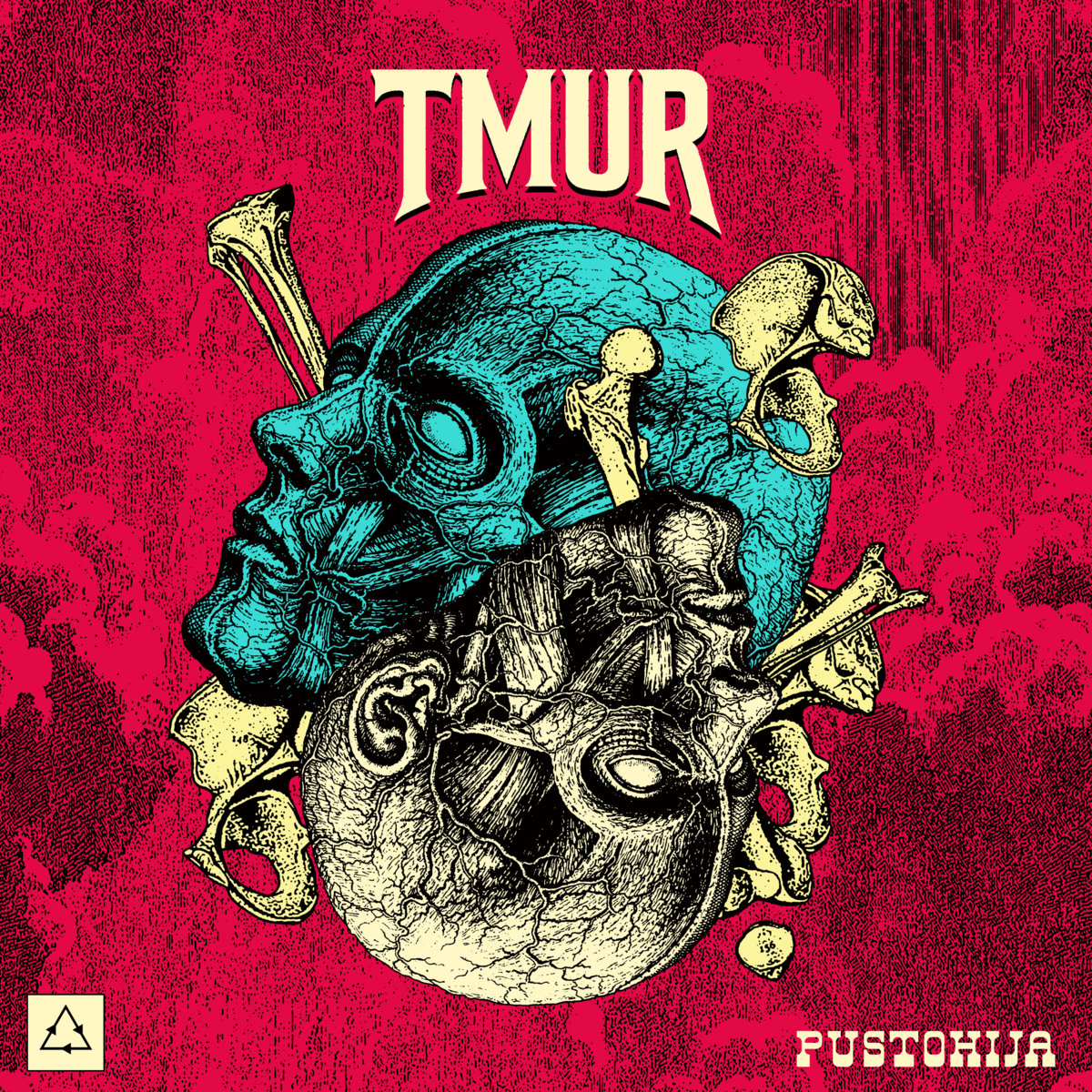
TMUR describe Pustohija not as four compositions but as “a single, continuous ritual”. The Skopje quartet, who evolved from a duo through a series of live performances before committing this material to record, have made something that resists conventional rock listening habits and rewards surrender instead.
Released on AKSIOMA in July 2026, Pustohija sits in a lineage that includes Swans, Sleep, Earth, Om and Sunn O))): long-form, hypnotic, doom-adjacent music that accumulates weight through repetition. What distinguishes TMUR from their obvious reference points is the tambura, played by Popovski throughout, which pulls the record out of Western post-metal territory and into something distinctly Balkan. Ancient, ritualistic, folkloric, it transforms what might otherwise be a competent doom record into something with genuine regional identity.
Opener S’klet is the most immediately accessible entry point with its heavy, sludgy drumming beneath a simple hypnotic riff, before breaking into something eerier and more atmospheric, the tambura surfacing alongside psychedelic rock that builds back toward heaviness. It’s the track that best demonstrates TMUR’s range within a single composition.
Amanet is the album’s most ambitious statement, featuring fourteen minutes of bass and drums with subtle electronic intervention, minimalist and slow-burning by design. The band clearly consider it the record’s centrepiece. Originally I found it the weakest moment — the repetitive riffing occasionally tips into monotony rather than hypnosis, and the sounds blur into each other in a way that other tracks avoid. But after several listens, slowly absorbing the mesmeric progression, it’s starting to grow on me. The drum breaks around the halfway point land with real force as the composition accelerates.
Pustohija (’Wasteland’) is where everything clicks. Popovski’s tambura takes centre stage, carrying the listener through vast, unknowing landscapes — something like ISIS’s Panopticon filtered through Balkan modality. Progressive, atmospheric, desert-like, with an undercurrent of doom; Dante descending through the Inferno, step by step, the destination uncertain. It’s certainly the most compelling piece here.
Bezdan closes with the album’s most aggressive energy in the form of a distorted, fragmented sound before settling into raw stoner rock. Powerful riffs and sludge are stripped bare. A blunt ending to a record that’s spent most of its runtime being anything but blunt.
For a debut from a band still finding its footing through live performance, Pustohija is a striking introduction. The tambura alone makes it worth the time of anyone interested in what’s emerging from the heavier side of Skopje’s underground right now.
Where to Find Them
- Bandcamp: listen & support on Bandcamp