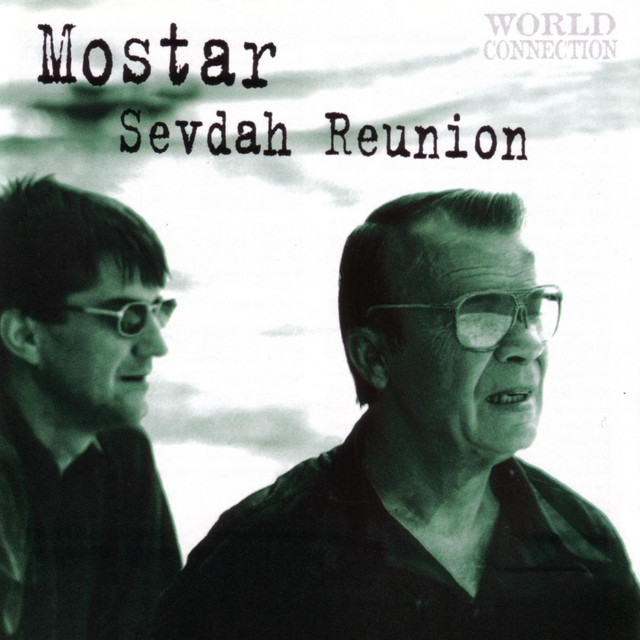
Recorded in 1998 and released in 1999, Mostar Sevdah Reunion’s self-titled debut represents a raw, unfiltered document of sevdah revival that the band would spend the next decade refining into something far more compelling.
At the heart of the album is sevdalinka, the deeply emotional urban folk tradition of Bosnia and Herzegovina. Rooted in themes of longing, love, and melancholy, sevdalinka carries a weight that goes beyond music, reflecting a cultural memory shaped over centuries, featuring strong Ottoman influences embedded in both melody and lyrical expression.
It’s worth noting up front that approaching such a genre of music, like sevdalinka, as an outsider to the tradition, inevitably shapes the encounter. Rather than a definitive analysis, the review became more of a personal discovery of a genre that is rich, complex, and not always immediately accessible to listeners coming from other musical backgrounds.
The album stretches to nearly an hour, unfolding across a series of traditional songs reinterpreted through a fuller band arrangement. Tracks like Mujo kuje konja po mjesecu immediately stand out, bringing a sense of energy and movement with soulful vocals and rhythmic drive.
Elsewhere, Mostarski dućani and U Stambolu na Bosforu lean more heavily into the genre’s historical and geographical roots. The presence of accordion, violin, and intricate string arrangements highlights the Eastern influences that define much of sevdalinka’s sound, evoking a space that feels both intimate and expansive.
There are also more extended, slower compositions, such as Đul Zulejha, where the focus shifts toward repetition and emotional intensity. These moments emphasise longing and atmosphere, though over time they can feel slightly drawn out, particularly for listeners less attuned to the genre’s traditional structures.
Across the album, the musicianship is undeniable. Instrumental passages — especially on Snijeg pade na behar, na voće and Pšeničica sitno sjeme — showcase a richness in arrangement and performance that remains consistently engaging. The interplay between instruments often becomes the most compelling aspect, offering variation within a framework that can otherwise feel stylistically consistent.
At the same time, that consistency presents a challenge. The combination of ornate melodies, emotive vocal delivery, and dense instrumentation creates a powerful sound, but over the course of a full hour it can begin to feel overwhelming. The intensity rarely lets up, and the arrangements can feel somewhat uniform, making individual tracks harder to distinguish from one another.
What becomes clearer when exploring the band’s later work — particularly Café Sevdah (2007) — is that this isn’t an issue with the genre itself, but with the execution of this release. Café Sevdah feels far more refined and balanced: the vocals are more controlled, the arrangements are more spacious, the emotional weight allowed room to breathe. In contrast, Mostar Sevdah Reunion comes across as a much rawer document.
This gives the album an interesting place in the band’s catalogue. It captures the early energy and intention behind the project — a revival of sevdah in its most direct and unfiltered form — but lacks the subtlety and depth they would later develop.
Mostar Sevdah Reunion remains an important and culturally significant release, and a necessary entry point into the sevdalinka tradition for newcomers. But it feels a lot like a stepping stone, a stepping stone toward a sound that the band would go on to refine into something far more compelling on later records.