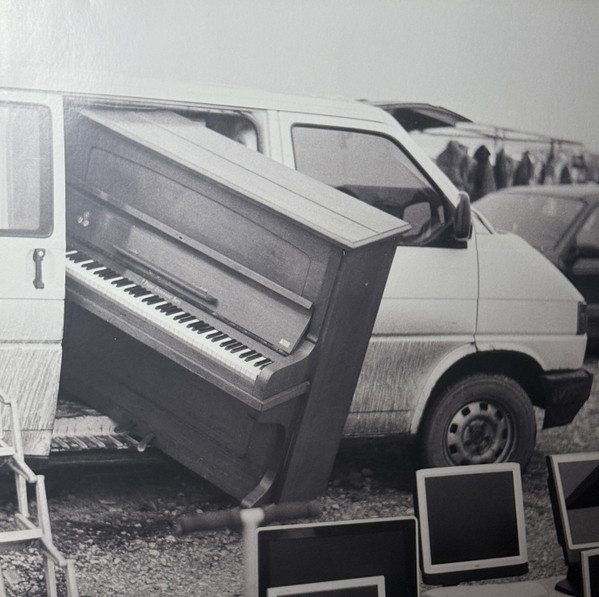

Beton Kino is the second album by Croatian experimental outfit Roj osa, and it arrives as an expansive, uncompromising double LP. Released in November 2025 via Zagreb’s Kopaton Records, the record feels like a fractured film reel with its raw textures, abstract electronics and cinematic tension stitched together by an international lineup that includes Rob Mazurek, whose presence looms heavily over the album’s restless, visionary atmosphere.
Brothers Nenad and Alen Sinkauz are key figures in the Croatian experimental and improvisational music scene, as well as respected composers of theatre and film music. They are joined here by Rob Mazurek, the internationally renowned cornetist and composer whose collaborations across jazz and experimental music have made him a frequent visitor to Croatia’s contemporary arts circles.
The album takes its name from the theatre in Split where it was recorded.
The core trio is Alen Sinkauz (bass, Pulsar-23, Lyra-8, effects), Nenad Sinkauz (electric and MIDI guitar, live electronics), and Marco Quarantotto (drums, percussion). They operate in constant friction, while Mazurek’s cornet, trumpet, bells, voice and samplers cut through the chaos like an unreliable narrator. The result is an album that feels deliberately unstable, teetering between free jazz, IDM, and apocalyptic post-rock. Much of the record carries a loose, exploratory feeling of live improvisation — you can feel ideas being discovered and shaped in real time.
Opening track Rustroot throws you straight into the deep end: glitchy, distorted and abstract, it feels like a bad trip you can’t wake up from. Free jazz and IDM shouldn’t coexist comfortably — and yet here they are, entangled, twitching and malfunctioning together in a dystopian haze. It’s unsettling, disorienting and strangely compelling.
Stone Sage evokes that particular avant-garde strain of Ljubljana free jazz I’ve discussed previously — chaotic, physical and slightly unhinged — bringing to mind projects like Miladojka Youneed or Begnagrad. It’s musicians testing the structural limits of the music, seeing how far it can bend without snapping.
Then comes Dandelion, a brief moment of relief. Light, breezy, and atmospheric, it’s one of the album’s more accessible passages, with traces of almost cosmic post-rock drifting through its textures.
That tension resurfaces on Asphalt Henbane, where the IDM/jazz hybrid returns in full force. It’s a bizarre collision of musical forms: Aphex Twin’s Drukqs rubbing shoulders with Bitches Brew. At times the music echoes the ritualistic, exploratory spirit of Miles Davis’s record — less traditional jazz fusion and more a dense, swirling environment where distorted electronics and brass circle around each other.
Chickweed Crossroads begins the album’s descent into a sort of ritualistic chaos. The trumpet drifts in and out like flies hovering over decay, while the keys remain oddly delicate and composed. It feels both sophisticated and slightly grotesque at the same time — a deeply unsettling Hannibal Lecter-like energy. Where Is Gogi has a similarly wild, unpredictable and almost manic execution too later on in the record.
Nettle opens with a funky, almost irresistible bass-and-drum groove before moving into darker jazz-fusion territory as Mazurek’s trumpet enters the frame, carrying a faintly sinister atmosphere. When the guitar arrives, the mood briefly softens, introducing an ethereal moment of calm within the tension.
Smokestack Ivy stands out as one of the album’s most restrained and atmospheric pieces. Post-rock and math-rock elements emerge here, wrapped in ambient textures and subtle free jazz flourishes. Slow, patient and genuinely replayable, it’s one of the record’s most fully realised compositions.
Beton Kino is a strange, unsettling and often brilliant record. It fuses styles that feel fundamentally opposed — IDM, free jazz, fusion, post-rock and electronic abstraction — yet somehow finds a coherent emotional language between them. Much of the album unfolds with the loose, exploratory energy of improvisation, ideas emerging and mutating in real time. It won’t be for everyone, but at a time when many musical avenues feel fully explored, Beton Kino uncovers something genuinely strange and novel — a sound that may divide listeners, yet remains undeniably distinct and captivating.
Where to Find Them
- Bandcamp: listen & support on Bandcamp