On 5th July 1990, Prishtina had no television and no radio. Serbia had suspended Kosovo’s Assembly, days after its Albanian delegates declared Kosovo a republic. That night, according to the journalist Blerim Shala, the last rock concert at the city’s Youth Palace was Gjurmët, the band that had defined Kosovo’s 1980s scene. As the refrain “Më trego si të bëhem hero…” (“Tell me how to become a hero…”) rang out, Shala remembers everyone in the hall facing the same two thoughts. One was hopeful: this would pass soon. The other was harder and truer: there was no going back.
That concert closed a decade in which Prishtina built a real rock scene, with new wave, punk, synth-pop and hard rock, festivals of thousands, and bands that wrote songs about the system they lived under. However, almost none of it reached a record store.
That’s the paradox at the heart of this guide. Kosovo’s music scene wasn’t held back by a lack of talent, or even a lack of infrastructure. It grew up inside state institutions that gave it stages and a voice, but controlled what got recorded and published. The result was a scene that was big live, but rarely recorded, and almost entirely unwritten about in English.
And it wasn’t only rock. In the 90s, the first hip hop crews found that the studios only wanted folk, pop and rock, and jazz musicians still argue about who gets a stage. This guide traces Prishtina’s music from those first new wave bands, through the underground of the 90s and the rappers, DJs and jazz players who came after, to the bunker where a new generation records today.
Since we started EX-YU Music, we’ve covered music from cities across the Balkans, but Prishtina’s story hasn’t been told yet. Many of these records aren’t on streaming services or written about in English, so in addition to writing about them, we’ve been adding them to the EX-YU Music Archive. This guide is your way into Prishtina: not the full history, but a brief guide to the people and the strange conditions that helped build this music scene.
Before the 80s
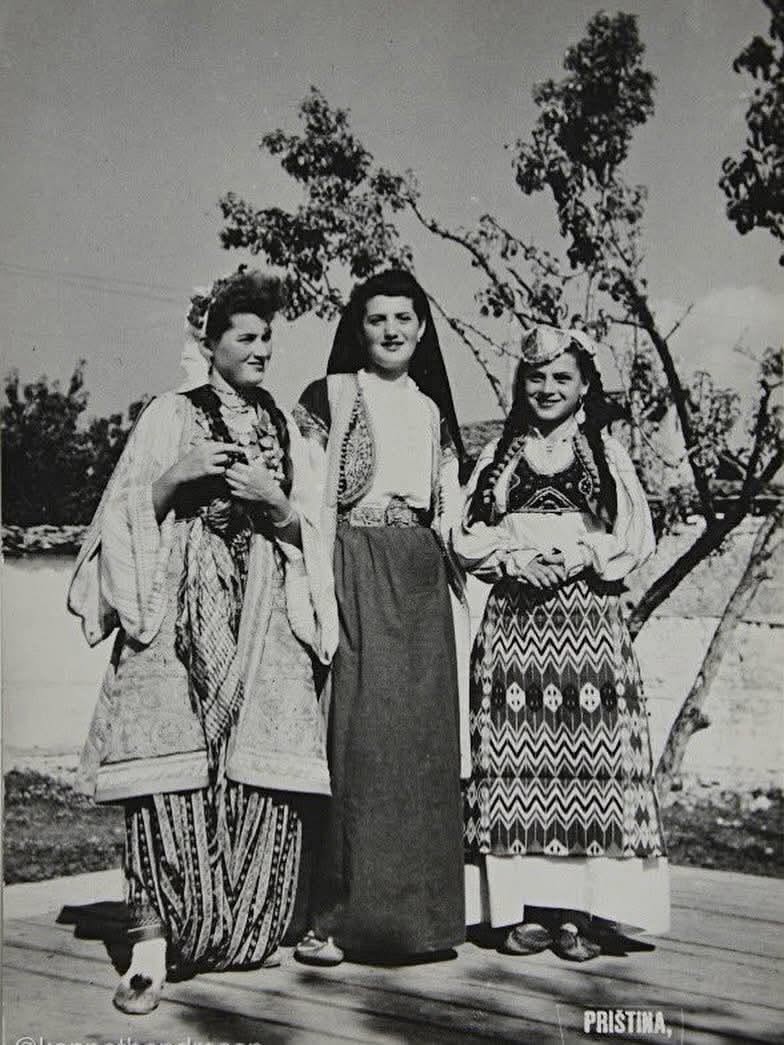
Two institutions shaped everything that would follow. First, the University of Prishtina, which opened in 1970, after the 1968 demonstrations, and by the early 80s the city had around 30,000 students. And second, Radio Prishtina, which later became Radio Television Prishtina (RTP) in 1973-1974, just before the 1974 Yugoslav constitution made Kosovo an autonomous province.
The music the institutions did champion was folk and “light” music, and its biggest star was Nexhmije Pagarusha, often called the queen of Albanian music. A Radio Prishtina soloist from the 1950s, she was among the first musicians from Kosovo to perform beyond the province, at a 1956 festival of Yugoslav radio stations in Cetinje. She became one of the stars of Akordet e Kosovës, the pop festival that launched in 1963 and became known as the Albanian San Remo. This was the sound of official Kosovo, and the music the rock bands of the 80s would both push against and borrow from.
In the early 70s, the rock scene centred on Mitrovica, with Albanian and Serbian bands playing to largely separate audiences, plus a couple of short-lived mixed groups such as MAK and FAN. MAK, led by Haki Misini, even won awards at the Akordet e Kosovës festival with a folk-rock sound that followed the path Bijelo Dugme had opened across Yugoslavia.
Still, it was in the 80s, and in Prishtina, that would prove fertile ground for musical innovation in Kosovo.
The 80s: stages without records
Kosovo’s 80s rock lives between two dates: 11th March 1981, when students filled Prishtina’s streets demanding a Republic of Kosovo, and 5th July 1990. The protests were violently suppressed, and what followed was a decade that Blerim Shala, who lived it, describes as politically and culturally suffocating, with “very few oases of air”. Yet, rock provided one of them: “a kind of paper shelter, and we knew it well.”
A scene inside the state
Yugoslavia is often remembered as the freest country in the socialist world, but those freedoms weren’t shared equally. Kosovo Albanians were widely treated as third-class citizens, and “nationalism” and “irredentism” were regularly used as reasons to restrict their freedoms. This shaped the music directly.
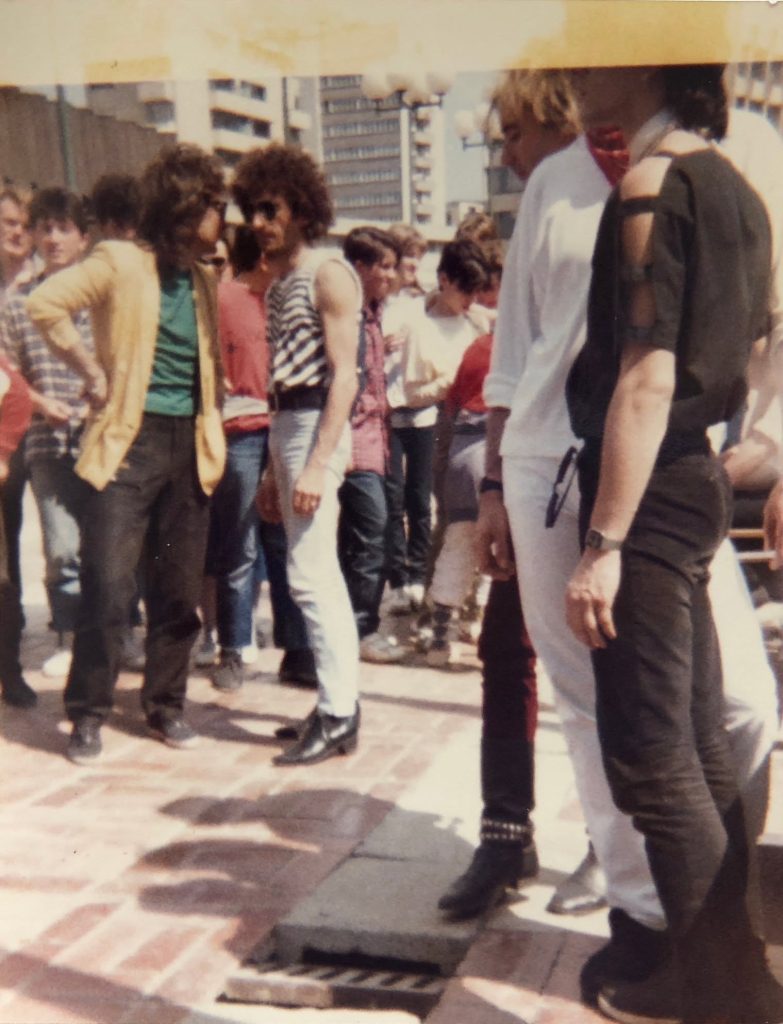
The scene grew up inside state institutions: Radio Prishtina’s Second Programme put rock on air, and the Youth Palace’s Universal Hall held up to 10,000 people. From 1982 to 1987, the Socialist Youth League backed BOOM, Kosovo’s biggest rock festival, run by volunteers from the bands themselves. The first edition, on 3rd September 1982, had around 20 bands, with Galija from Niš headlining. One researcher calls it the “Woodstock of Kosovo”. Bijelo Dugme played Prishtina in 1983, and their song Kosovska is described as the only Albanian-language song performed by a major non-Albanian Yugoslav rock band.
The same system that built the stages controlled the studio. RTP was the only recording studio in Kosovo. It had been releasing Kosovo’s music since the 1950s, but almost all of it was traditional and classical, and the establishment running it (writers and classical composers) viewed alternative rock as a form of degeneration. Songs judged “morally degenerating” were blocked or had their lyrics changed, and from 1985, lyrics had to go to a “text controller” before recording. The big Yugoslav labels were based in Zagreb, Belgrade and Ljubljana, not Prishtina, so RTP’s Music Production unit was, in effect, Kosovo’s record company. And much of what it did record didn’t survive. After Albanian staff were dismissed in 1990, a large part of RTP’s archive, thousands of discs and tapes, “disappeared, probably damaged or destroyed”, according to the musicologist Kristina Perkola.
So bands learned to talk in code. Songwriters, Shala writes, relied on metaphor and hidden messages “wrapped in a load of meaningless lines”. The punk band Bankrott had to record their 1985 song In WC we are as In CC we are. In the video, the singer swaps his microphone for an electric razor.
Gjurmët and Lindja
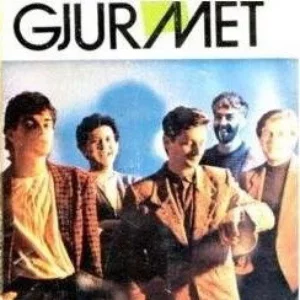
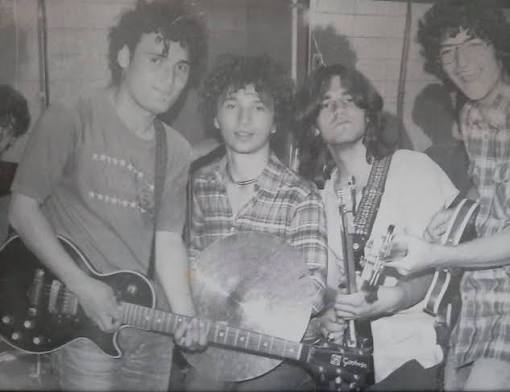
As written in our review of their sole album, Gjurmët were the anchor of the scene. Formed in Prishtina in 1980 by Migjen Kelmendi, son of the writer Ramiz Kelmendi, they were inspired by the Novi Val movement spreading across Yugoslavia. Often described as Kosovo’s first new wave band, they soon ran into trouble: RTV Prishtina refused to broadcast their 1982 recording Karrigat over its criticism of the system. Another track, Mikrofoni, focused on the surveillance that followed the 1981 protests. Even their debut’s cover was a fight. It was shot with dancers performing the Albanian eagle dance, but released with a band photo instead, Kelmendi checking his wrist at how long the delay had dragged on.
The music is a distinctive mix of new wave, pop rock, and Albanian folk, less angular than most new wave of the era: folk-inflected, but fundamentally pop at heart. N’tren Për Perzeren has a chorus that’s genuinely incredible, and on Rrezet Thehen Në Sytë E Tu Të Zezë the fusion really clicks, with angular basslines and uptempo drums still rooted in an Albanian folk vocal identity. They split in 1986 when Kelmendi was called up for military service. In 1988, they recorded Heroi i Qytetit Pa Lum (“Hero of the Riverless City”), named after Prishtina’s two rivers, the Vellusha and the Prishtevka, buried under concrete as the city grew.
Read our full review of Gjurmët.
Lindja, formed in 1983, represented the scene’s experimental side. They were more punk and took their lead from Idoli, Pekinška Patka and Paraf. But they never got a studio album — their songs survived only as RTP recordings and videos, and were collected on an album after the Kosovo war.
The rest of the scene
Around them was a whole scene. Minatori (Naser Gjinovci and Mufail Limani) lasted for decades. Other names include Ilirët, Seleksioni 039, Bankrott, the synth-wave of Ëndrrat Moderne and Vivien, and 403. Shala calls 403 the most promising band of the era, and says they “never got where [they] deserved”. The BOOM lineups also included Fisnikët, Trix, Tonik, TNT and Eufonia, and FAKS, described as Kosovo’s first Turkish rock band. Some bands, such as Minatori, Ilirët and Gjurmët, drew on folk, partly to show that rock and patriotism weren’t opposed.
The Prishtina scene was also largely cut off from the wider Yugoslav new wave. Albanians were often seen as poor and “uncultured”, and when 403 were due to play Jugovizija in Opatija, they were mocked as “backward”. The music drew on the same currents as Zagreb or Belgrade, but mutual recognition and collaboration were rare.
A common story across the entire Yugoslavia: Western records found their way into the region. Many young Kosovans were living in London in the 80s and sent tapes and records home. The scene had famous names you might not expect; for example, the rock band Oda was fronted by Dukagjin Lipa, Dua Lipa’s father.
In 1987, after Milošević’s speech at Kosovo Polje, BOOM held its last edition in Kosovo. As Shala puts it, rock here was always closer to Sisyphus than to the Stones.
The 90s: the parallel scene
After July 1990, musicians scattered around the world and into other careers as the scene fragmented. Albanians were pushed out of state jobs, schools and RTP, and built a parallel society in its place. Students were taught in Albanian in private houses and apartment blocks, and could be beaten if the police caught them.
With the institutions gone, musicians went where they could. Albanian musicians turned to cafés, Perkola writes, as “the only alternative possibility”: “Pop and rock music dominated mostly in the bars and clubs in towns, while folk-patriotic music dominated mostly in village odas.” (Odas are the guest rooms of traditional Albanian houses.) Music became a national tool in the peaceful resistance.
The old institutions didn’t disappear quietly, either. In 1995, after a five-year break, Akordet e Kosovës tried to return at the Youth Palace, by then the Palace of Youth and Sports. The first night went ahead; the police stopped the other two. On 26th December 1996 it tried again, on a freezing night, ringed by cordons of Serbian police, with every song mimed to playback. It was the festival’s last edition.
Music transitioned underground as well. Kurrizi (“the spine”), a tunnel complex of small bars and clubs in Dardania, had played everything from jazz and new wave to punk and metal since the 80s. In the early 90s it became “a meeting point for artists and political movements”, says Toton Pllana, and “built the fundamental musical and cultural base for a generation”. Serbian police raided it again and again, beating people simply for being there, until it closed.
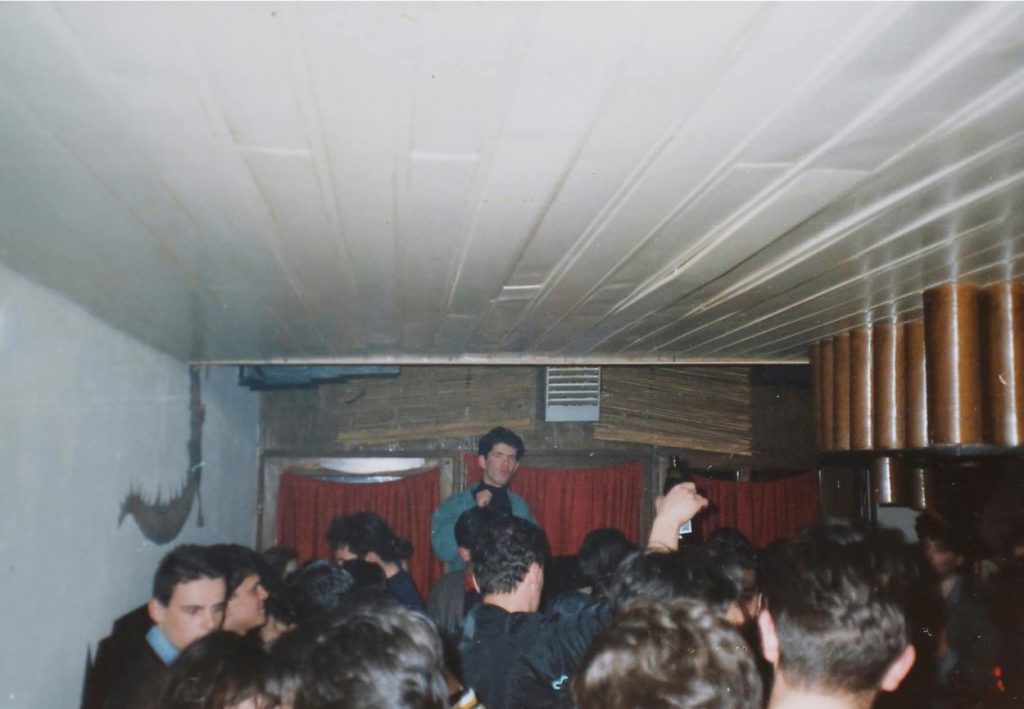
Still, life in Kosovo continued in strange forms. Parties, known as zhurkas, were held during the day, because curfews and movement restrictions made nights impossible. Small gigs took place at Dodonë, which Toton Pllana remembers as “a strange and funny theater, small, with deafening death-metal bands”, where groups competed against each other. Instruments and equipment were so scarce, he jokes, that people thought math-metal had been invented in Prishtina.
A few small bars stayed open, and hip hop arrived, finding an audience in the cracks of society. From 1989, Pici (Arian Rexhepi) and Blerim Krasniqi taped songs off the radio, watched MTV and VIVA, ordered singles from video clubs and caught rap on Serbian TV’s Treći Kanal. As the crew Gangs in da Hood, they wrote in English at first: “It was unimaginable to make this music in Albanian.” But the lyrics and social undercurrents of 90s hip hop resonated: “Rappers were talking about racial discrimination and abuse by the police in the US,” Bersant Rizaj told Resident Advisor; “Kosovo-Albanians were living under the same thing here.”
By the early 90s, there were crews such as Trouble Makers, Nice and Slow, New Enemy and Black Eagle, rapping in bars with “the rock band behind us”, as Pici puts it, because the studios only wanted folk, pop and rock. “We were at ground zero.” In 1994 the crew Colors made the first Albanian-language hip hop video, “Kjo është jeta jonë” (“This Is Our Life”), about police stations, visas and poverty. By the late 90s, Ritmi i Rrugës, Tingulli 3, 2po2 and others were spreading on cassettes, local radio and the hugely popular New Year’s tapes.
Alongside hip hop, a heavier sound found its feet too. TERROR, Prishtina’s first all-women metal band, were “well known during the war”. One member, the acting student Vjosa Shala, kept two diaries from 1988 to 1999, filled not with writing but with newspaper clippings, maths homework, drawings, gig posters and party invitations. They’re now online as Two Journals (Dy ditarë), a project led by Nita Deda with Rina Meta, and they’re a rare first-hand record of the decade.
After 1999: a different universe
On 4th September 1999, 86 days after the war ended, DJ Njeri, who had been playing acid house and techno since 1989, organised a Love Parade through Prishtina. “We had been saved from being wiped out,” Oda Haliti told Resident Advisor. “The way a lot of people wanted to celebrate was with a big party.” Clubs followed: Underclub in 2000, then MhZ, Radio Club and Spray, which, from 2004, brought in UK tech house DJs, among the first foreign artists to play the city.
The post-war years were, in many ways, when Kosovo’s alternative scene truly took shape, but it started from almost nothing. Making music is expensive in a poor country. There was nowhere affordable to rehearse in Prishtina, so bands practised in damp garages, and anywhere else “the police would be called on us”, says Galdon Reçica of the metal band Frisson. Crowds had shrunk too. Ilir Dalipi, later a founder of Defy Them, recalls asking established bands how many people came to their gigs. “About a hundred,” they said proudly, against the roughly 2,000 he remembered from the old days.
The war left its mark in quieter ways too. Dritëro Nikqi of por-nó, who fled to Budapest the day the NATO bombing began, told the writer Stu Sherman in 2004 that people “wouldn’t talk about what happened, wouldn’t tell their stories”. “It’s like they want to start over and erase ten years.” The new generation grew up on whatever radio and the post-war CD stalls offered. Rock split roughly in two, while hip hop, electronic music and jazz each found their own way back.
The indie and alternative side
- Retrovizorja, Polaroid (2002): dark, claustrophobic alt-rock with progressive instrumentals.
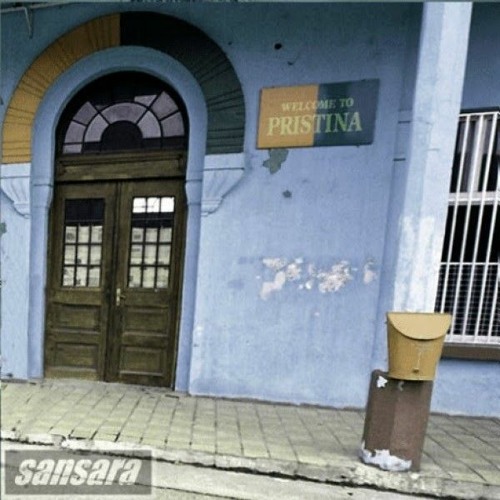
- Sansara, Welcome to Pristina (2003): a whole album in thrall to 90s Britpop and neo-psychedelia, with Oasis and Blur all over it. One of the most fascinating records from Prishtina.
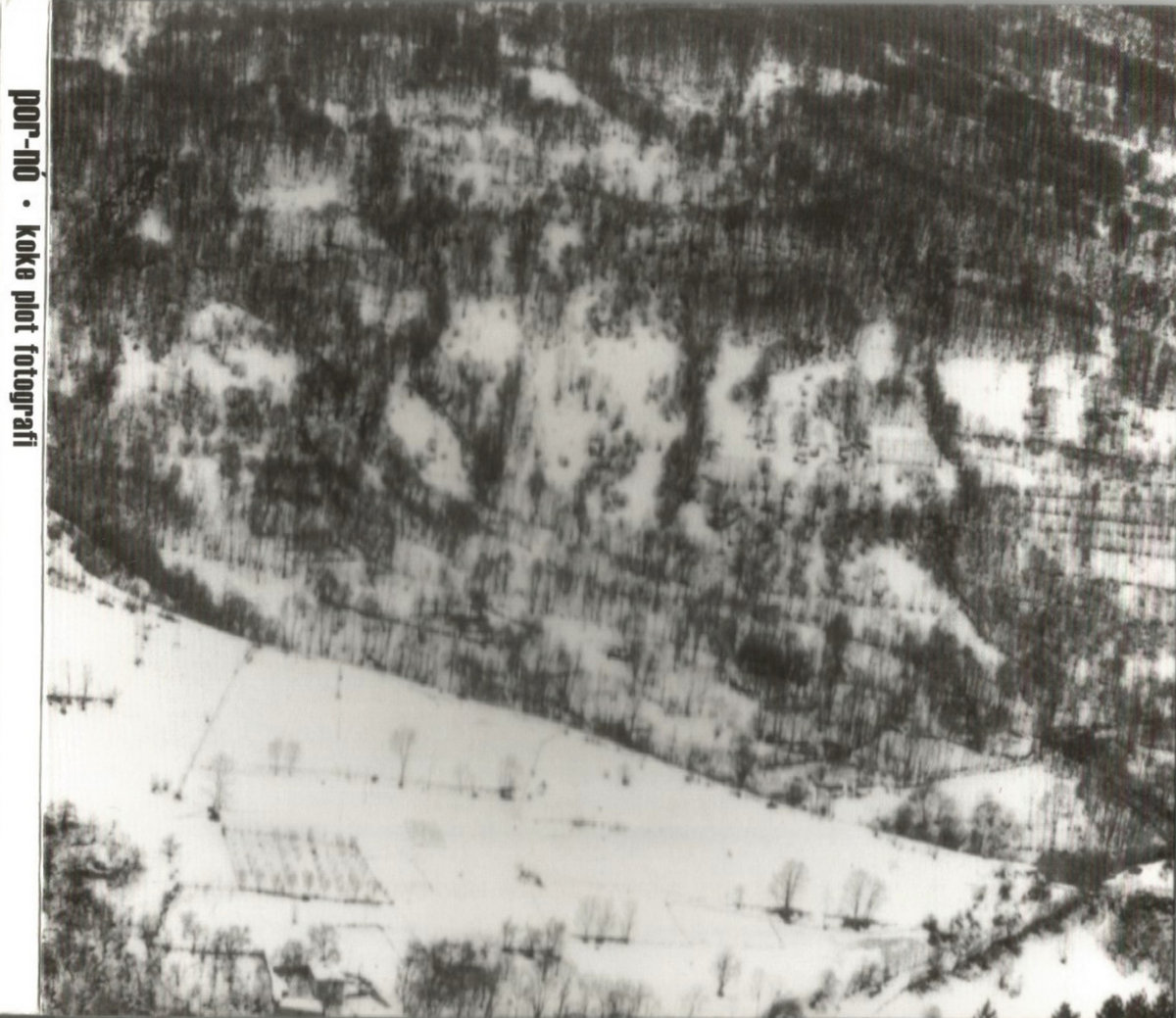
- por-nó, Kokë Plot Fotografi (2004): one of the first bands to emerge after the war, and less a band than a rotating community of musicians. A cold, wintry record that moves naturally between alt-rock, post-rock and jazz-rock, like a darker Radiohead. Read the review.
- Gillespie, Diku, dikur…: a 2017 release that’s best described as noisy indie-rock with a slight emo twist.
- Asgjë Sikur Dielli: dark and damp alt-rock fused with metal and electronic elements; second album Ndodhemi (2005) is a must-listen.
The metal scene
Jericho brought a Rage Against the Machine energy, and Troja worshipped Pantera and Metallica. By the late 2000s, Prishtina had a proper metal scene, centred on the “metal corner”: two bars, Hard Rockers and Prishtina Rockers Cafe, on Bill Clinton Boulevard opposite the electricity company. Bands included Toxin, the folk-leaning Diadema, Lufta Popullit, and MadGod, whose guitarist calls the heaviest band Kosovo ever had. Long hair could still get you into trouble. “People wanted to eat me!” one guitarist remembers from the early 2000s.
The old gatekeeping hadn’t gone away either. In 2010, MadGod and other heavy bands recorded a segment for KTV’s New Year’s Eve broadcast, and were cut from the show. According to guitarist Almir Fazlijevic, a friend who called the station was told they were “too heavy for this nation”. In 2017 an official at the Ministry of Culture said its musicians’ fund tended to favour “more serious music”. From RTP in the 80s to the 2010s, Kosovo’s institutions kept preferring “serious” culture to rock, under very different political systems.
By 2017 the metal corner had faded, and the Rock Per Rock festival had shrunk from three days to a single battle of the bands. Frisson, whose 2015 debut was called Exit Denied, won it in 2016. Their bassist said bluntly that “metal as metal is becoming extinct.”
Hip hop
Hip hop was the real post-war winner. In late 1999, thousands packed the Boro-Ramiz hall, the same Youth Palace where Gjurmët had played in 1990 and Akordet had been shut down in 1996, for a rap gig organised by Dany Boy, with KFOR handling security. In 2001, he started one of the first radio shows devoted to hip hop.
The landmark record is NR’s Egjeli (2003). NR’s first track, Shumë vrasje (“Many Killings”), was written in 1998 by a 14-year-old Burim Kursani, better known as BimBimma: “We as kids, instead of playing in the parks… wrote about how our people are being chased, kidnapped, abducted, massacred, beaten.” Egjeli broke the rules. Earlier rappers had used standard Albanian, the Tosk of newspapers and books. NR rapped in Prishtina’s own Gheg dialect, swore on record, and went after UNMIK and the post-war politicians. Albanian rap has been made that way ever since. “I see hip hop as journalism,” BimBimma says. “You do your journalism, I’ll do mine.”
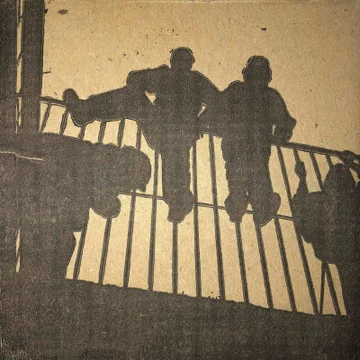
Then there’s Unikkatil, who left for New York just before the war and released his music only online and on CDs passed around internet cafés, with barely a photo of him in circulation. When he finally played Prishtina’s stadium in 2012, more than 20,000 people came.
By then hip hop had become the sound of Kosovo. In 2007, 50 Cent played to 25,000 people at the same stadium. Set that beside rock bands proud to draw a hundred, and it says a lot about what the post-war generation wanted. Women have been part of the story too, from Blerta Zeqiri, now better known as a film director, to Mc Chika and, more recently, Rreze Osmani, who won one of Termokiss’s open-mic rap battles.
The jazz thread
Kosovo’s jazz story starts not in Prishtina but in Mitrovica, and much earlier than you’d think. In the 1920s, a British company took over the Trepça mine and brought in engineers from across Europe (“some German, a Pole, a Czech, a Slovenian, an Englishman…”), and with them dance balls, brass and jazz. Under socialism, foreign music counted as “imperialist”, so players kept to instrumentals, or sang “I love you, you love me” lyrics, saxophonist Gazmend “Gazi” Mustafa recalls, “in order to avoid any ideology”.
The key figure was Pera Rakić, who worked at Radio Prishtina and used it to lend local bands instruments and airtime. Once a man told him he’d learned the double bass, so Rakić drove the radio’s double bass to Mitrovica strapped to the roof of his Renault 4. The man, it turned out, couldn’t play. Out of jam sessions at the Lushta Quay hall, Rakić built a 20-piece Big Band of door repairmen, woodworkers and party secretaries: Albanians, Serbs, Bosnians and Turks. Asked about its ethnic make-up, he said: “I never counted.” The band staged the Mitrovica Jazz Festival in 1989, which only ever had one edition. In the 90s the Big Band simply dissolved: “The rehearsals just stopped. Nobody asked them anything.”
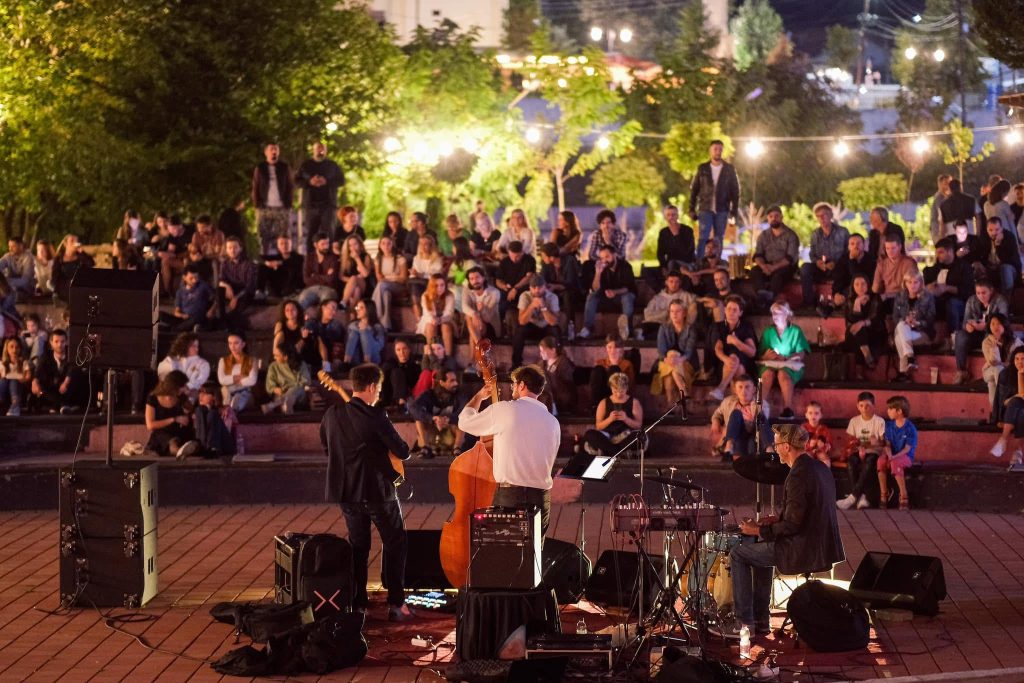
After the war, the story split along the river. In 2003 musicians in north Mitrovica launched the North City Jazz & Blues Festival, while in Prishtina, that same year, a reunited Big Band led by the composer Valton Beqiri played its first concert. In Prishtina, Ilir Bajri founded the Prishtina Jazz Festival, bringing players like Uri Caine to the Oda Theatre alongside locals such as the OM Quartet. Today there’s also the Peja Jazz Festival and an active jazz scene with notable releases in the 2020s from the Visar Kuçi trio, Nesim Maxhuni, Enver Muhamedi, and the Marimanga Trio.
Modern Day
The answer to “metal is dying” came the very next year. In 2018, Ilir Dalipi, Kombetar Uskana and Ilir Berisha founded Defy Them in Prishtina’s Bregu i Diellit neighbourhood: a community rock label, recording studio, music school and gig space in one. It started in rented garages in Dardania, next to a car wash whose damp seeped into everything. Then it moved into an old bunker. Within about a year of the move, some 20 new bands had formed there. “Each concert here resembles a protest,” says their PR manager, Arbër Selmani.
The music that RTP once kept off record is now being recorded on the scene’s own terms. Names to start with:
- Elektorati Intelektual: dark, heavy post-punk with shades of post-rock and metal (2014).
- Kosovo Art Collective and the Tetris Recording Sessions. Experimental electronic.
- The Milksnatchers. Post-punk with English lyrics.
- From the Defy Them orbit: Frisson, Zwada, Sandcastle Mom, Telikput, and Lira Blakaj.
Today, the electronic scene that began with the 1999 Love Parade has its own spaces. Since 2014, the Hapësira collective has thrown parties in the Rilindja Warehouse, the old printing house of the Albanian-language Rilindja press; a building that once printed Albanian voices now hosts the scene. Termokiss, a community centre in a former power-plant building, runs music workshops and Shirit, a cassette night where people bring their parents’ old Yugoslav and Balkan tapes.
Beyond Prishtina
The capital isn’t the whole story. In Prizren, Kolektivi began in 2023 as an online radio in a small room above a bar off the main square. It now hosts weekly jam sessions and pay-what-you-can nights, with DJs tuning in from Germany, Turkey, Brazil and Finland. The city’s Turkish-speaking musicians add their own thread, from Barış Manço-loving rockers to bands like Agregat. Mitrovica, where Kosovo rock began in the 70s, has produced Jutbina, who mix rock with post-punk, indie and hip hop.
the hall and the bunker
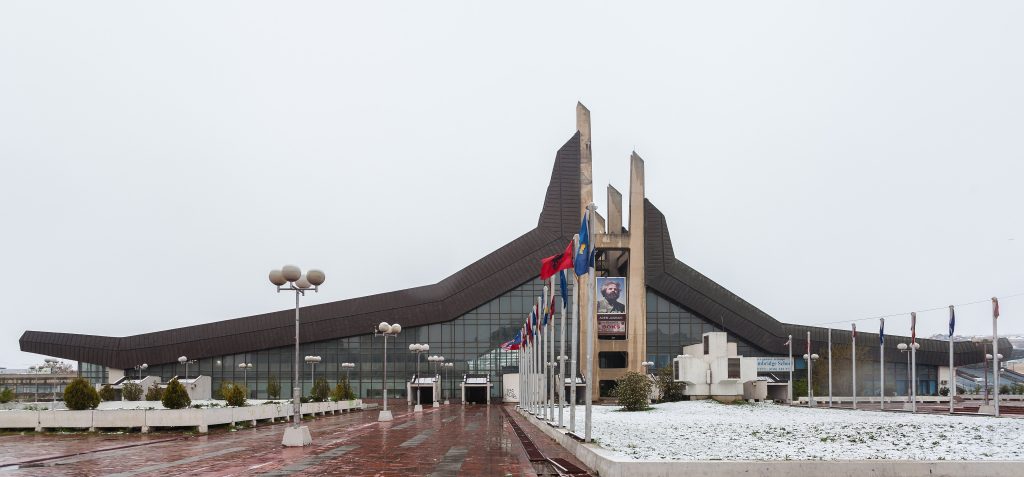
Prishtina’s music keeps passing through the same building. The Youth Palace held the crowds of the 80s and Gjurmët’s last concert on 5th July 1990. In the 90s, under a new name, it was where Akordet e Kosovës was shut down by police cordons. Months after the war, it filled again for the rap gig that launched a new generation.
Gjurmët’s 1988 song mourned the rivers of the Riverless City, buried under concrete. Much of the music in this guide went the same way: into lost archives, unreleased RTP tapes and cassettes nobody catalogued. Now it’s resurfacing, in a bunker in Bregu i Diellit, in a teenager’s diaries put online, in a cassette night of parents’ old tapes. The scene that was big live and barely recorded is finally being written down. Hopefully, this guide is our small contribution to that.
Explore Prishtina on the EX-YU Music Archive → Rate these records, add the ones we’ve missed, and make your own list. Click here!
Sources and further reading
This guide owes most to the research of Lura Limani, Rina Krasniqi and Bardhi Haliti, whose BOOM project has done more than anyone to document Kosovo’s 80s rock scene.
- Blerim Shala, “Grupi 403 dhe të tetëdhjetat e rokut në Kosovë”, Zëri, January 2003; republished by Telegrafi, 1 September 2023 (in Albanian)
- Lura Limani and Rina Krasniqi, “Kosovo’s Youth BOOM: 1982–1987”, Stacion
- This is how we ended too. What?, exhibition at Stacion, Prishtina, 2019, curated by Vala Osmani and Albert Heta
- Edona Kryeziu, “Inside Yugoslavia’s Albanian rock scene”, K2.0, 11 March 2020
- Rina Krasniqi, “BOOM Concerts in 1980s Kosovo”, Changing the Story, University of Leeds, 2019
- Valmir Mehmetaj, “Kosovo’s shrinking metal scene”, K2.0, 21 November 2017
- Isabelle Fennema, “Defy Them: How Underground Music in Kosovo is Challenging the Mainstream”, Prishtina Insight, 30 August 2023
- Arian Lumezi, “Sounds from the Kolektivi community”, K2.0, 30 December 2025
- Erik Da Silva, “On the traces of Migjen Kelmendi”, New Eastern Europe, 28 February 2025
- Stu Sherman, “Kosovo’s Burning: Punk Rock and Albanian Rap in a War Zone”, Anthem Magazine
- Kit Macdonald, “‘A Fantastic Secret’: How Kosovo’s Club Scene Became An Antidote To Isolation”, Resident Advisor, 8 June 2021
- Alberina Haxhijaj, “Dy ditarë” (“Two diaries”), Koha, 10 June 2021 (in Albanian)
- Vjosa Shala, Two Journals, twojournals.com
- Ngadhnjim Avdyli, “Kosovar hip-hop evolution”, K2.0, 2 June 2019
- Jack Robinson, “BimBimma: the seminal voice of conscious Albanian hip-hop”, Prishtina Insight, 22 August 2019
- BIRN, “Hip Hop Becomes the Sound of Kosovo”, Balkan Insight, 5 August 2010
- Kristina Perkola, History of Art Music and Musicology in Kosovo from 1945 to 2020, PhD thesis, University of Zagreb, 2024
- Sanja Sovrlić, “Mitrovica’s Jazz Age”, Prishtina Insight, 26 January 2017
- Lamy Istrefi, “My jazz story”, K2.0, 20 June 2025
- Arif Muharremi, “All That Jazz in Kosovo”, Balkan Insight, 18 November 2008
Thanks to Lum and to the researchers and archivists whose work this guide leans on, including Rina Krasniqi, Lura Limani, Bardhi Haliti, Nita Deda and Kristina Perkola.
Last updated 17/10/2026. Know a record or a story we should add? Get in touch.